Why Are Wall Sockets Important for Global Buyers?
Wall Sockets may look like small components, yet they influence safety, convenience, and product acceptance across global markets. A socket connects household users with electricity every day. Its design affects charging, appliance use, installation time, and long-term maintenance. For international buyers, the details matter: voltage compatibility, outlet configuration, grounding, shutter protection, material quality, and certification requirements can differ significantly between regions.
Electrical-safety specialist Martyn Allen has emphasized the practical principle that electrical products must be safe, suitable, and used as intended. That principle belongs at the center of every Wall Sockets purchasing decision. A buyer examining a sample should check more than its polished faceplate. Look closely at terminal strength, flame-resistant plastic, screw alignment, protective shutters, and the clarity of installation instructions. A loose connection may remain invisible during a factory inspection, then create heat inside a busy hotel wall.
Performance matters.
Global buyers also need reliable documentation and supplier communication. Test reports, traceability records, warranty terms, and production consistency can reveal more than attractive product images. However, compliance marks alone do not guarantee good performance. This is an uncomfortable point, but it deserves attention. A certified product can still fail when installed incorrectly or matched with unsuitable wiring. Buyers should therefore assess the socket, the manufacturer, and the intended environment together. Residential projects, hospitals, offices, and industrial facilities may require different protection levels. The best purchasing decision is not always the cheapest one. It is the one that remains safe, practical, and dependable after thousands of daily connections.
Global Socket Standards: IEC 60884-1, 250 V AC, and 16 A Ratings
For global buyers, wall sockets are safety interfaces, not simple plastic fittings. IEC 60884-1 covers household and similar socket-outlets rated up to 250 V AC and 16 A. These figures define the product’s tested range, not a universal installation permission. Local rules, wiring systems, frequency, earthing, and plug geometry still matter.
The IEA Electricity 2024 report expects global electricity demand to grow by about 3.4% annually from 2024 to 2026. More powered equipment means greater pressure on everyday connection points. A 250 V, 16 A socket can theoretically handle 4,000 watts at a purely resistive load. Real conditions are less neat. Heat, loose terminals, cable size, and repeated switching can reduce safe performance.
During procurement checks, buyers should compare the socket marking with IEC 60884-1 test evidence and local certification requirements. Look for shutter protection, contact temperature limits, mechanical strength, and resistance to abnormal heat. Indoor and damp-area applications also need different protection decisions. The rating label is only the beginning. Small detail. Big consequence. Some product sheets still show “16 A” without explaining the test conditions, and that deserves a second look.
Regional Plug Types: Comparing Type A, C, G, and I Configurations
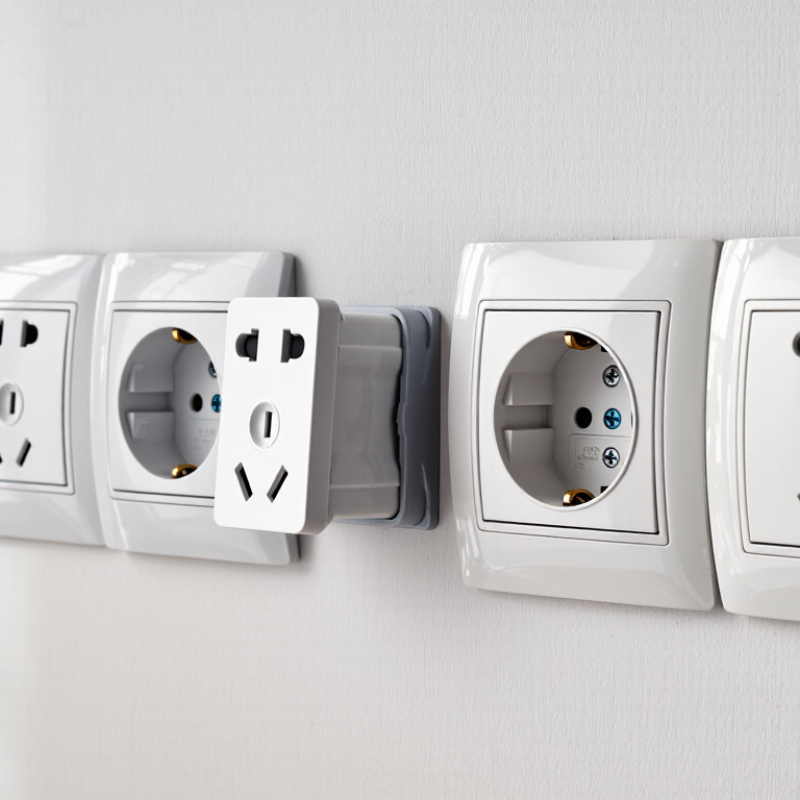
Wall sockets matter because they connect a product to real household conditions. A technically sound device can still fail when its plug does not match the local outlet. During purchasing inspections, I check the socket shape, pin spacing, grounding method, shutters, and rated voltage. Small mismatches create loose connections, heat, or damaged adapters. Fit matters.
Type A uses two flat, parallel pins and is common in North America and parts of Asia. Some Type A outlets have no grounding connection, while grounded versions use an additional contact. Type C uses two round pins and appears across much of Europe, Africa, and South America. Its compact design suits many appliances, but it does not provide a dedicated earth connection. Buyers should not treat a Type C plug as universally safe for every device.
Type G has three rectangular pins, a fuse arrangement, and strong grounding protection. It is widely used in the United Kingdom and several related markets. Type I uses two angled flat pins, with a grounding pin on many versions. It is associated with Australia, New Zealand, China, and Argentina. Local variations exist. They are easy to overlook. IEC 60884-1 and regional approval requirements provide useful reference points, but documents alone cannot replace physical testing. A careful sample check should include insertion force, contact temperature, cable strain, and repeated plugging. I sometimes see attractive universal designs pass visual review yet perform poorly under repeated use. That gap deserves more attention.
Why Are Wall Sockets Important for Global Buyers? - Regional Plug Types: Comparing Type A, C, G, and I Configurations
| Plug Type |
Pin Configuration |
Grounding Design |
Typical Electrical Systems |
Common Markets |
Typical Current Rating |
Key Considerations for Global Buyers |
| Type A |
Two flat, parallel pins. The neutral pin is commonly wider than the live pin in polarized versions. |
Generally ungrounded. Grounding is not provided through the two-pin plug itself. |
- Approximately 100–127 V AC in many markets
- 50 or 60 Hz, depending on the country
|
Common in the United States, Canada, Mexico, Japan, and several Central American and Caribbean markets. |
Often used with appliances rated up to approximately 15 A, subject to the national standard and socket design. |
Check both voltage and frequency before export. A Type A plug may fit some Type B sockets, but it does not provide an earth connection. |
| Type C |
Two round pins, usually with a 19 mm center-to-center spacing. The plug has no earth-contact system. |
Ungrounded, two-pin configuration. |
- Most commonly 220–240 V AC
- Typically 50 Hz
|
Widely used for low-power, double-insulated appliances across much of continental Europe, parts of Africa, South America, and Asia. |
Common Europlug versions are rated up to 2.5 A. |
Type C plugs are compact and widely recognized, but they are unsuitable for appliances requiring protective earth or higher current. Socket compatibility can vary by country. |
| Type G |
Three rectangular pins arranged in a triangular pattern, with the earth pin positioned above the live and neutral pins. |
Grounded design. The earth pin also operates the safety shutters in compatible sockets. |
- Approximately 220–240 V AC
- Typically 50 Hz
|
Used in the United Kingdom, Ireland, Cyprus, Malta, Malaysia, Singapore, and several other markets influenced by British standards. |
Common domestic plugs are rated up to 13 A and normally incorporate a replaceable fuse. |
Plugs, sockets, fuses, and cable sizes must comply with the destination market’s safety requirements. A Type G socket normally accepts only the matching rectangular-pin configuration. |
| Type I |
Two flat pins arranged in an inverted V shape. A third flat earth pin may be present, depending on the plug version. |
Grounded versions include a separate earth pin; two-pin versions are ungrounded. |
- Commonly 220–240 V AC
- Typically 50 Hz
|
Used in Australia, New Zealand, China, Argentina, and several nearby or related markets. |
Common household configurations include 10 A; higher-current versions, such as 15 A, also exist in applicable standards. |
Pin angle, earthing arrangement, and current rating must match the destination standard. Do not assume that all Type I sockets accept every Type I plug variant. |
Important: Plug shape does not determine electrical compatibility. Before finalizing a product for export, verify the destination country’s nominal voltage, frequency, grounding requirements, socket dimensions, current rating, wiring rules, and applicable safety certification requirements.
Electrical Safety: How IEC 60529 IP Ratings Protect Socket Users
Why Are Wall Sockets Important for Global Buyers?
Wall sockets support daily power access, but moisture can turn convenience into danger. IEC 60529 defines IP ratings for enclosure protection. The first digit measures resistance to solid particles. The second measures water protection. An IP20 socket offers no water protection. An IP44 model resists objects above 1 millimetre and splashing water. IP55 adds stronger dust protection and water jets. These details matter in kitchens, workshops, balconies, and humid commercial spaces.
Electrical faults are not rare. Consumer safety data from the United States estimates about 32,000 home fires each year involve electrical distribution or lighting equipment. The figure comes from recent five-year fire-loss analysis. An IP rating cannot prevent overloads, loose terminals, poor grounding, or incorrect installation. That limitation is easy to overlook. A socket may survive splashes while its wiring remains unsafe. Global buyers should check local voltage, frequency, plug configuration, temperature range, and installation requirements. IEC 60529 testing also does not measure impact strength or child protection.
Tips: Match the IP level to the actual location, not the product photograph. Check the test report and marking on the enclosure. Ask whether the rating applies after installation. A covered outdoor socket may need a higher rating than an indoor model near a sink. Dust, condensation, and damaged seals deserve attention during inspection. Safety often fails at the small details.
Compatibility Checks: Voltage, Frequency, Grounding, and Certification Data
Why Are Wall Sockets Important for Global Buyers?
Wall sockets are more than visible fittings on a wall. They connect equipment to a building’s electrical system. For global buyers, compatibility begins with voltage, frequency, and plug geometry. A socket rated for 220–240 volts may not suit a 100–127 volt market. Frequency also matters, especially for timers, motors, and sensitive control devices. Check the product label, technical sheet, and installation instructions together. Small differences can create serious heating or performance problems.
Grounding deserves careful attention. A grounded socket needs a reliable earth path, not only a third contact. Ask for the wiring diagram and confirm the terminal layout with a qualified electrician. During a project review, I compare the socket drawing with the actual sample. I once trusted a photograph and missed a grounding detail. That shortcut was avoidable. Physical inspection remains useful.
Certification data should be specific and traceable. Request the test report, certificate number, issuing laboratory, product model, rated current, voltage, frequency, and grounding method. Check the testing standard and its edition. Also review the certificate date and coverage. A certificate alone may not prove that every production batch is identical. Sample testing can reveal loose terminals, weak shutters, or heat damage. Requirements differ by destination, so buyers should verify local electrical rules before placing large orders.
Why Are Wall Sockets Important for Global Buyers?
Compatibility depends on four checks: nominal voltage, frequency, grounding, and the certification standard required in the destination market.
| Market |
Nominal voltage |
Frequency |
Grounding / certification reference |
| North America |
120 V |
60 Hz |
Protective earth; UL 498 / CSA C22.2 No. 42 |
| European Union |
230 V |
50 Hz |
Protective earth; IEC 60884-1 / EN 60884-1 |
| United Kingdom |
230 V |
50 Hz |
Protective earth; BS 1363 |
| Japan |
100 V |
50/60 Hz |
Grounding varies by outlet type; JIS C 8303 |
| Australia |
230 V |
50 Hz |
Protective earth; AS/NZS 3112 |
| China |
220 V |
50 Hz |
Grounded and ungrounded forms; GB/T 2099.1 |
| India |
230 V |
50 Hz |
Protective earth; IS 1293 |
The chart compares representative nominal supply voltage and frequency. A socket designed for one market should not be treated as universally compatible: voltage affects insulation and safety, frequency affects some motors and timers, grounding affects shock protection, and certification standards determine whether the product can legally be placed on the target market.