- Home
- About Us
- Products
- Total Solution
- News
- Blog
- Contact Us
Leave Your Message
-
-
Phone
-
E-mail
-
Whatsapp
-
Whatsapp

Choosing an Off Grid Inverter is not just a matter of picking the highest wattage on a product page. It is about matching the inverter to the loads, battery bank, and daily energy use in your home or cabin. A refrigerator may run quietly at modest power, then demand a sharp surge when its compressor starts. That brief moment matters. Small details count.
PV systems educator John Wiles’s technical guidance can be distilled into one useful rule: match every component to its real operating limits, not just its headline rating. This guide applies that principle to seven practical checks, including continuous output, surge capacity, battery voltage, charging functions, waveform, idle consumption, and safety protections. The numbers on a specification sheet are a starting point, not a guarantee of performance in your installation.
Think about the devices you actually use: a well pump at dawn, a laptop charging overnight, or lights running during several cloudy days. Check whether the inverter can handle those loads together, and confirm that its charging features suit your batteries. Read the manual, verify cable and ventilation requirements, and compare the warranty and service support. These steps can feel tedious. They are still worth doing. A system may work well on paper and disappoint in the field, especially when loads change or temperatures fall. Use the seven tips below to narrow your choices, then confirm the final design with a qualified installer when your setup is complex.
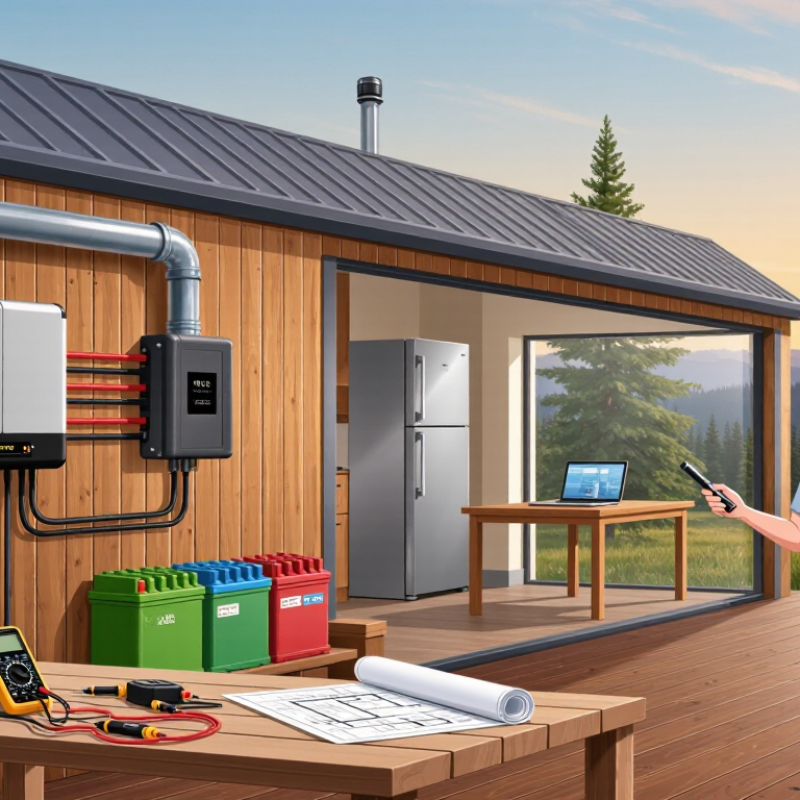
Before comparing inverter ratings, record what your home actually uses. List each appliance, its watts, hours of use, and likely overlap. A refrigerator cycling overnight, lights, a laptop, and a water pump can create a very different load from a kettle used alone. The U.S. Energy Information Administration reported average residential electricity consumption of 10,791 kWh per customer in 2022, roughly 29.6 kWh per day. That figure is a useful reference, not an off-grid target; climate, household size, and heating equipment change the picture.
Measure a typical week if possible. A plug-in energy meter can track smaller appliances, while a qualified electrician can assess hardwired loads. Then estimate the largest loads likely to run together, and check motor-starting surges from pumps, compressors, or refrigerators. Short peaks matter. An inverter may support a high surge briefly but not continuously, so compare both ratings with your measured loads and appliance manuals. Add a modest margin for growth, but avoid sizing from guesses alone. I once overlooked a workshop compressor; the daily energy looked manageable, yet its startup demand changed the inverter choice. That is easy to miss. Keep notes, revise the estimate, and treat the EIA figure as context rather than a substitute for household measurements.
Use the sample figures below as a planning example, not as measured household data. Actual consumption and starting power vary by appliance; check appliance labels or use a power meter before selecting an inverter.
| Tip | What to Assess | Illustrative Data | How to Use It |
|---|---|---|---|
| 1. List your daily loads | Estimate each appliance’s energy use in watt-hours (Wh) per day. | Example: lighting 400 Wh, refrigerator 1,200 Wh, laptop 300 Wh, router 288 Wh, fan 360 Wh, pump 375 Wh, and small appliances 200 Wh. Total: 3,123 Wh/day (3.12 kWh/day). | Calculate energy as watts × hours of use. For cycling appliances such as refrigerators, use measured or manufacturer-stated daily energy rather than multiplying rated running watts by 24 hours. |
| 2. Separate daily energy from peak power | Daily energy is measured in Wh or kWh; instantaneous load is measured in watts (W). | In this example, the refrigerator may draw about 150 W while running, while the pump is rated at 750 W. Their short-term demand is not shown by the daily kWh total alone. | Choose inverter capacity based on the appliances likely to run at the same time, not only on total daily energy. |
| 3. Estimate concurrent running load | Add the running watts of loads that could operate simultaneously. | If the example loads are all on together, using 80 W for lights, 150 W for the refrigerator, 60 W for a laptop, 12 W for a router, 45 W for a fan, 750 W for the pump, and 500 W for small appliances gives about 1,597 W. | A 25% planning margin would bring this illustrative running-load target to about 2,000 W. Confirm the actual combination of loads before sizing. |
| 4. Check starting or surge power | Motors and compressors can briefly draw more power when starting than while running. | For illustration only, a pump with a 750 W running rating might have a starting demand around 1,500 W, and a refrigerator running at 150 W might briefly require around 450 W. Actual values can differ substantially. | Check appliance starting-current specifications and the inverter’s surge rating and surge duration. Allow for the possibility that more than one motor starts at once. |
| 5. Account for conversion losses | Inverter efficiency affects how much energy must come from the battery. | At an assumed 90% conversion efficiency, delivering 3.12 kWh of AC energy requires about 3.47 kWh from the DC side, before accounting for other system losses or inverter idle consumption. | Compare efficiency at realistic operating loads and include conversion losses when estimating battery and solar requirements. |
| 6. Match inverter and battery voltage | Confirm that the inverter’s DC input voltage matches the battery bank and that the battery can supply the required current. | A 48 V, 100 Ah battery has a nominal energy of 4.8 kWh. If 80% is treated as usable, that is 3.84 kWh DC; at 90% inverter efficiency, it could deliver about 3.46 kWh AC under these assumptions. | Usable capacity depends on battery chemistry, settings, temperature, and manufacturer limits. Check continuous and surge discharge ratings as well as nominal capacity. |
| 7. Verify system compatibility and protection | Check the inverter’s battery-charging, solar-input, output-waveform, and safety specifications. | Confirm the supported battery voltage and chemistry, PV input voltage and current limits, AC output voltage and frequency, overload protection, and required disconnects and overcurrent protection. | Compare all limits with the battery, solar array, and appliances. Have wiring, grounding, and protective devices designed and installed to applicable local electrical codes. |
Sample daily-energy calculation: 400 + 1,200 + 300 + 288 + 360 + 375 + 200 = 3,123 Wh/day. Appliance wattage, operating time, and surge demand should be verified for the specific installation.